
From Waste to Wearable Art: How Sustainability Is Powering the New Era of Luxury Embroidery
- Arazzo

- Jan 30
- 5 min read
Updated: Feb 19

There's something almost sacred about watching an artisan's hands transform a simple piece of fabric into something extraordinary. At our atelier in Kolkata, we see this transformation happen every single day. But lately, that transformation has taken on a deeper meaning - because the materials passing through those skilled fingers are no longer just threads and beads. They're second chances.
Sequins crafted from discarded plastic bottles-once headed for landfills-are transformed into luminous surfaces for haute couture gowns. Threads spun from the same recovered waste replace conventional virgin alternatives, carrying both strength and story through every stitch. Beads developed from repurposed industrial plastics are reshaped into refined embellishments that rival traditional materials in finish and finesse. This is the quiet revolution unfolding within luxury embroidery, and it is, without question, the most exciting shift we have witnessed in our years of working alongside global fashion houses.
The Uncomfortable Truth We Had to Face
Let’s be honest about something. The embroidery industry-our industry-has historically been part of the problem. For centuries, we have operated within systems that prioritized beauty and longevity, with little attention paid to the origins of materials. Embellishments were valued for their perfection and consistency, not for their origin or journey. We all knew this. Yet for years, the prevailing belief was that sustainability and luxury existed in separate worlds—that clients investing in exceptional craftsmanship expected materials that were pristine, newly produced, and untouched by any prior life.
We proved that assumption wrong.
When we started conversations with our partner brands about incorporating recycled materials, we expected resistance. What we got instead was relief. "Finally," one creative director told us, "someone who can help us do this without compromising on quality." That conversation changed everything about how we approach our craft.
What Sustainable Luxury Embroidery Actually Looks Like
Sustainability in embroidery isn't just about swapping materials - it's about reimagining the entire process. Here's what that means in practice at our workshop.
The material sourcing shift: It begins with discarded plastic bottles and industrial waste-materials that once had no creative destiny at all. Through careful sorting, deep cleaning, and considered processing, this waste is reimagined into entirely new forms, bearing no resemblance to what it once was. A sequin that started life as an everyday bottle may ultimately be embroidered onto a haute couture gown, worn by a model walking the runway in Milan or Paris. There is poetry in that transformation.
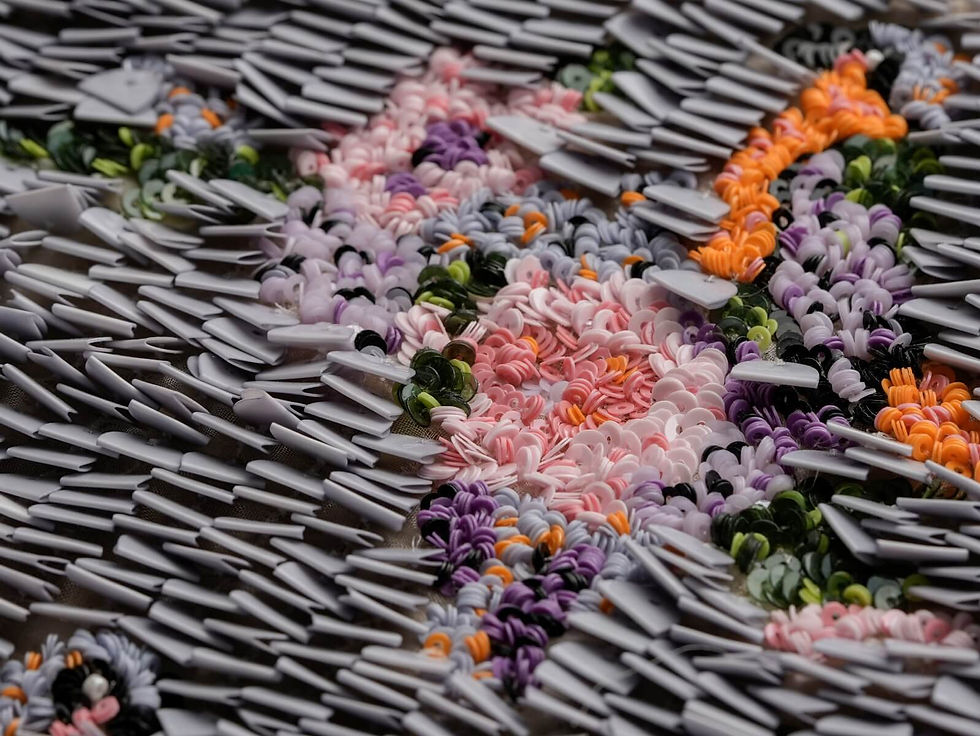
Bio-based alternatives: Not everything can be recycled, and hence where circularity hits limits, material innovation steps in. Bio-based resins are used to create distinctive beads and embellishments—shapes and textures that would be impossible through conventional routes. These materials are chosen thoughtfully, for moments where form, function, and responsibility are required to coexist seamlessly.
Zero-waste design philosophy: Our design team works backward from waste reduction. Before a single stitch is made, we calculate material requirements down to the last bead. Offcuts from one project become embellishments for another. What can't be reused gets sorted for recycling or composting.
The Craftsmanship Question
Here’s what every luxury brand wants to know: does the use of sustainable materials compromise the finished product? After hundreds of projects developed using recycled and bio-based materials, our answer is definitive-absolutely not. In fact, some of our most celebrated pieces have been created entirely from reclaimed materials.
The distinction lies in preparation and expertise. Extensive testing, material calibration, and design-led research ensure that every sequin, bead, and thread performs to exacting standards before it ever reaches an artisan’s hands. By the time embroidery begins, the process is seamless. Artisans with decades of experience in the craft are unable to distinguish-by hand or by eye-between conventional materials and their recycled counterparts.
What has changed is the origin of the materials. What has not is the essence of the work: the patience required to execute a perfect French knot, the precision of placing thousands of beads in exact alignment, and the artistry of bringing a design to life through needle and thread. Sustainability, in this context, enhances the heritage of embroidery rather than diminishing it.
Why Global Luxury Brands Are Making This Shift
The brands we work with aren't embracing sustainable embroidery because it's trendy. They're doing it because their customers - increasingly informed, increasingly demanding - expect nothing less.
Today's luxury consumer asks questions. Where did this come from? Who made it? What happens to it after I'm done wearing it? These aren't uncomfortable interrogations; they're invitations for brands to tell better stories. Sustainable embroidery offers a compelling narrative that fast fashion simply cannot replicate.
There's also the regulatory reality. The European Union, the United States, and several Asian markets are tightening requirements around textile sustainability. Brands that invest in sustainable supply chains now are future-proofing their businesses. Those who don't will find themselves scrambling to catch up.
But perhaps the most powerful driver is creative possibility. Constraints breed innovation. When we challenged ourselves to create luxury embroidery using only recycled materials, our design team responded with some of their most imaginative work. Limitations became launching pads.
The Human Element

We'd be telling an incomplete story if we focused only on materials and techniques. Sustainability in embroidery is fundamentally about people.
Our artisans - many of whom have practiced their craft for decades - are witnessing their work take on new relevance. They're not just preserving traditional techniques; they're proving that ancient skills can address modern challenges. There's pride in that realization.
Sustainable practices have also improved working conditions. Non-toxic dyes mean healthier workshops. Proper waste management means cleaner surroundings. Investment in sustainability is investment in the humans who make this work possible.
Looking Forward
We're under no illusion that the work is complete. Sustainable luxury embroidery is still evolving. We're constantly testing new materials, refining processes, and pushing our partners to meet higher standards. Some experiments fail. Many succeed. All of them teach us something.
What gives us confidence is the direction of travel. Five years ago, conversations about recycled sequins, recycled beads felt radical. Today, they're routine. The brands we work with are setting increasingly ambitious sustainability targets, and we're committed to helping them achieve those goals.
The future of luxury embroidery isn't about choosing between sustainability and quality. It's about recognising that true luxury - the kind that endures, that tells a story, that respects both maker and wearer - must be sustainable. Anything less isn't a luxury at all.
At Arazzo, we partner with global fashion and home textile brands to create hand-embroidered pieces that honour tradition while embracing sustainability. Every thread we weave tells a story - your brand's story, crafted with purpose.


Comments